Riding West with Zafron in My Blood: A Conversation with Sarvi Ghadim
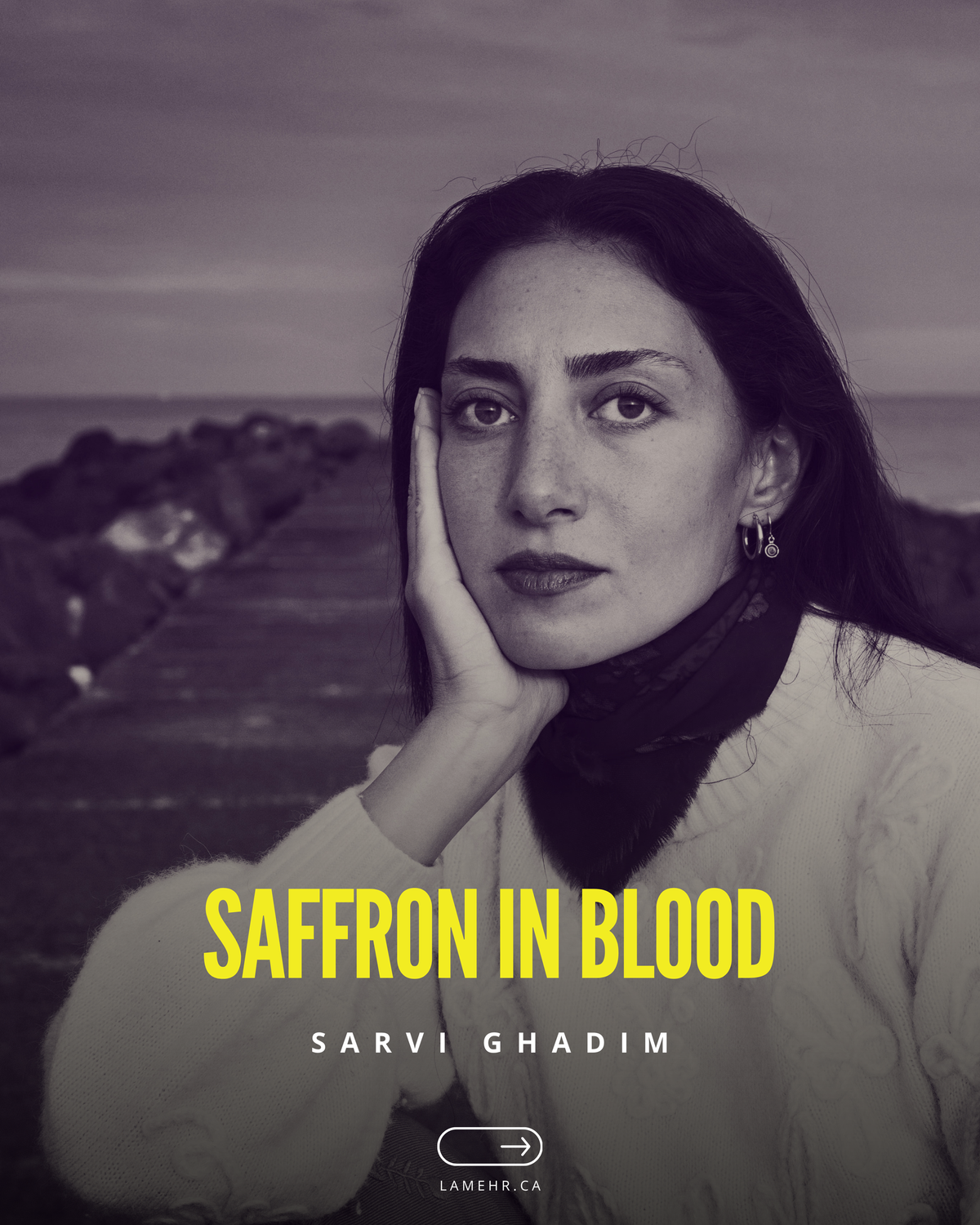
Sarvi Ghadim is an Iranian-Canadian visual artist whose large-scale oil paintings carry the warmth of saffron, pomegranate, and fire. Her debut solo exhibition in Toronto, Riding West with Zafron in My Blood, currently on display at RAID Gallery, brings together personal memory, cultural symbolism, and a deep attachment to Iranian heritage. A portion of proceeds from painting sales will be donated to an orphanage in Iran. Born in Iran and raised in Montréal, Ghadim has spent years navigating the quiet tensions of diaspora life, carrying Tehran in her memory while building a life that has taken her from Québec to Paris, where she now lives. Her work is autobiographical yet deliberately universal: figures are often faceless, allowing each canvas to become a mirror for themes of womanhood, belonging, endurance, and tenderness.
Trained not in fine arts but in political science — holding a Master's degree in international politics — Ghadim arrived at painting through reflection and catharsis. Recent events in Iran brought back long-buried memories of her adolescence in Tehran and the complex emotions of living between places. She picked up a brush to process what words could not contain, and from that first painting — a horse, the image that would anchor the entire exhibition — a whole visual world emerged.
Where did you grow up, and how connected are you to Iran?
I grew up in Montréal. I do live in Paris now — it's been two years. I'm back home in Montréal visiting family, and I came back for the art show in Toronto. I haven't visited Iran in a while now, unfortunately, but I remain deeply connected. I love the language. I love Farsi. I love speaking Farsi. Iran is part of my memory, my family history, and my artistic language.
Your art is very connected to Iran, and your exhibition title has saffron at its heart. Where did that come from?
A friend once told me, "I feel like you have saffron in your blood," and it stuck with me. I knew I was going to use that forever. I do have saffron in my blood — I grew up eating it. I use a lot of red and warm colours in my work, which I think is a direct representation of what I learned growing up as an Iranian: saffron is red, pomegranates, the colours of Yalda night, Chaharshanbe Suri — jumping over fire. All these warm colours are the language I grew up with. And we are in the West, so I feel like I'm riding west with saffron in my blood.
The women in your paintings — are you presenting yourself in those figures?
Yes, many of them are connected to me and to women I know. The figures are female, and I also love to paint animals because I see them as symbols of instinct, freedom, and movement. A lot of my paintings are faceless. I didn't want to give them a single identity or make them about one person. I wanted the figures to feel open — like they could hold many stories at once. I wanted to celebrate women through movement, dancing, and presence. I don't want to show only difficulty. The main purpose was to show resilience, sisterhood, and that sense of sorority — a bond I experienced strongly in Iran and in Iranian culture.
Did you study art, or did you come to painting from somewhere else?
I actually got my Master's in international politics. When I was younger, I was very interested in how societies work and how people live together. Over time, I realized that art allowed me to explore those questions in a more personal and emotional way. Painting became a place where I could express complexity without needing to reduce it to one argument or one answer.
The Woman, Life, Freedom movement — how did it affect your work?
They affected me deeply, though I always begin with people, not politics. I lived in Iran around 2009, and many memories from that period stayed with me. When more recent events began, it brought back emotions I had not fully processed. I was following the news from afar and thinking a lot about women, families, memory, and courage. I started my first painting, the horse, the one connected to the saffron title, during that period. At first, I was simply trying to release stress and find a visual language for what I was feeling. That is where the whole series came from.
How was the opening at RAID Gallery received?
It was great — a lot of people showed up. The paintings are very large, going from four feet to one foot; almost human-sized figures. I think that's what everyone talked about most, because it impacted them when they walked in. No one was expecting them to be that big, and they really responded to it. We sold out on the posters — the original paintings are still available, priced from $1,000 and up. The show is also part of the Toronto Art Crawl on July 9th, which I'm very excited about.
What's next for you after Toronto?
I'm working on another show in Paris — by the end of this year or early next year. It follows the same themes, but there will be a lot of faces this time. I'm dipping my toes into fantasy surrealism — still large-scale oil canvases, still lots of animals, but a new direction entirely.
Sarvi Ghadim's exhibition Riding West with Zafron in My Blood is on display at RAID Gallery & Cafe, 1720 Queen St W, Toronto, through August 2026. The show will also be featured at the Toronto Art Crawl on July 9, 2026. Original paintings are available for purchase starting from $1,000, with a portion of proceeds going to an orphanage in Iran. Follow her work at @sarv.naz on Instagram.